

How London Design Festival Turns a City into a Design Venue
From museum commissions to neighbourhood workshops, the annual festival shows how London’s design identity is built across institutions, studios and streets.

Editorial note: this independent profile is based on the public sources listed below. It is not an endorsement, paid placement or reported interview.
The city as the programme
London Design Festival was founded by Sir John Sorrell and Ben Evans in 2003 with a clear objective: celebrate design and reinforce London’s place as a global design capital. Its most useful idea, however, is spatial. The festival does not ask the city to visit one venue; it treats the city itself as the venue.
Landmark installations and museum commissions sit beside studio openings, talks, workshops and commercial showcases. The result is an annual map of how design operates across London rather than a single view of what design should be.
Neighbourhoods make the scale legible
The 2026 edition ran across eleven design districts and listed more than 350 events. Districts help turn an overwhelming metropolitan programme into local sequences: a visitor can move through a neighbourhood, encounter multiple practices and understand the relationships between studios, institutions and streets.
This is where the festival’s London character is strongest. Scale does not erase place; it is assembled from places.
Institutions and experiments in the same frame
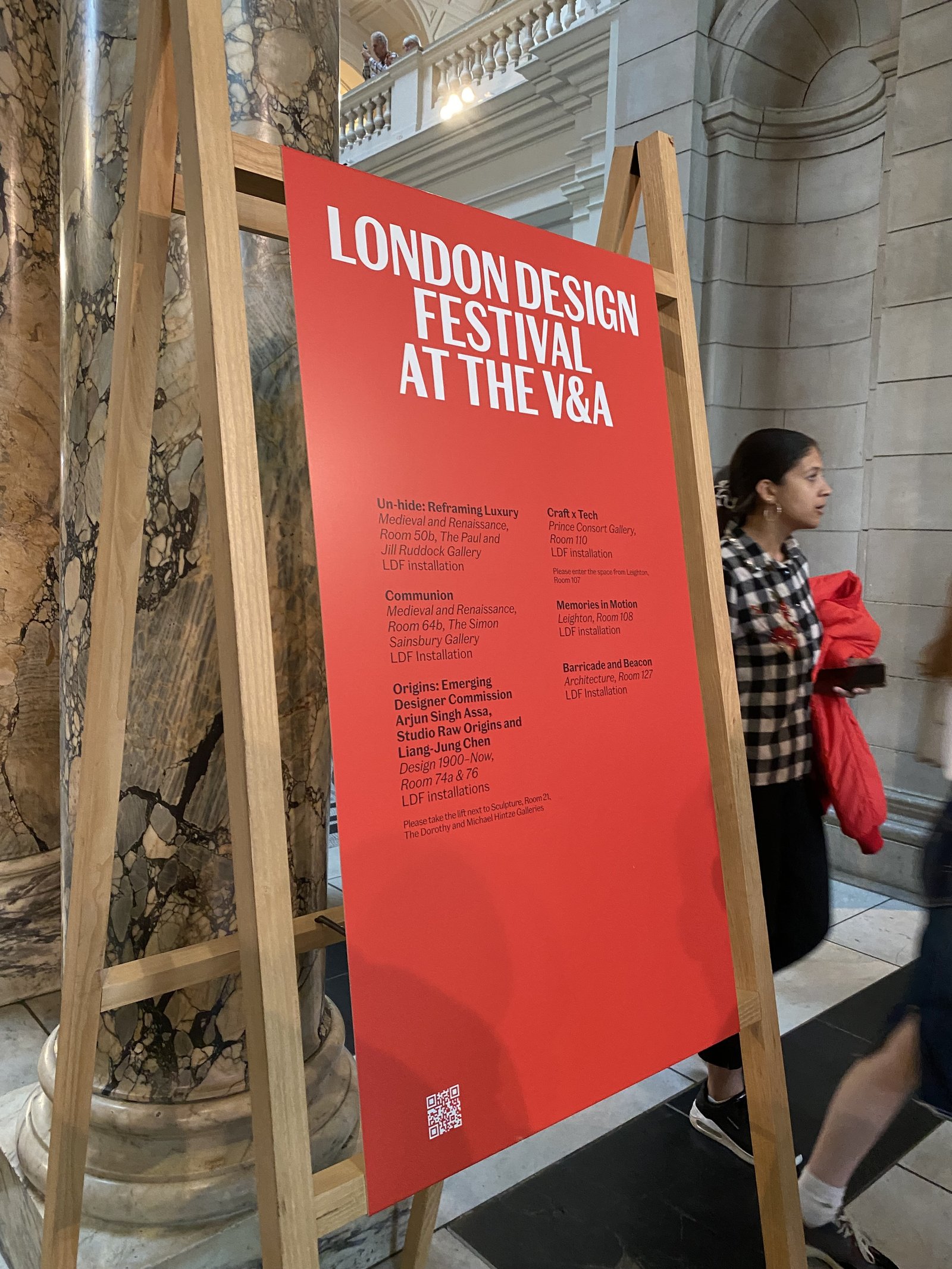
The Victoria and Albert Museum has long been a major festival partner, giving ambitious commissions a platform inside a national institution. Meanwhile, the wider partner programme lets smaller organisations and independent studios become visible within the same public calendar.
That coexistence creates useful friction. Design appears as industry, culture, craft, research and civic proposition, sometimes within a single day’s itinerary.
Why the format endures
The festival reported 600,000 visitors from more than 75 countries in 2019. Large numbers matter to city promotion, but the lasting value is more granular: a student finds a studio, a resident notices a workshop nearby, an international visitor sees London through the work being made here.
London Design Festival makes a recurring argument that the city’s creative authority is distributed. Its job is to make that network briefly easier to see.