

Yinka Ilori: Designing Joy Into London’s Public Life
From an Islington childhood to a Park Royal studio, the British-Nigerian artist turns memory, colour and participation into spaces Londoners can share.

Editorial note: this independent profile is based on the public sources listed below. It is not an endorsement, paid placement or reported interview.
Colour with a memory attached
Yinka Ilori’s work is immediately recognisable for its colour, but colour is not used as decoration alone. The British-Nigerian artist and designer connects bold pattern to family stories, Nigerian parables, textiles and the mixed identities of the north London community where he grew up.
That combination gives the work its particular generosity. It is visually direct enough to welcome a passer-by, while carrying references that reward longer attention.
From chairs to shared space
Ilori’s early practice centred on upcycled chairs. By 2022, the Design Museum said he had worked on more than 80. The chair was a useful starting point: familiar, functional and capable of holding both a body and a story.
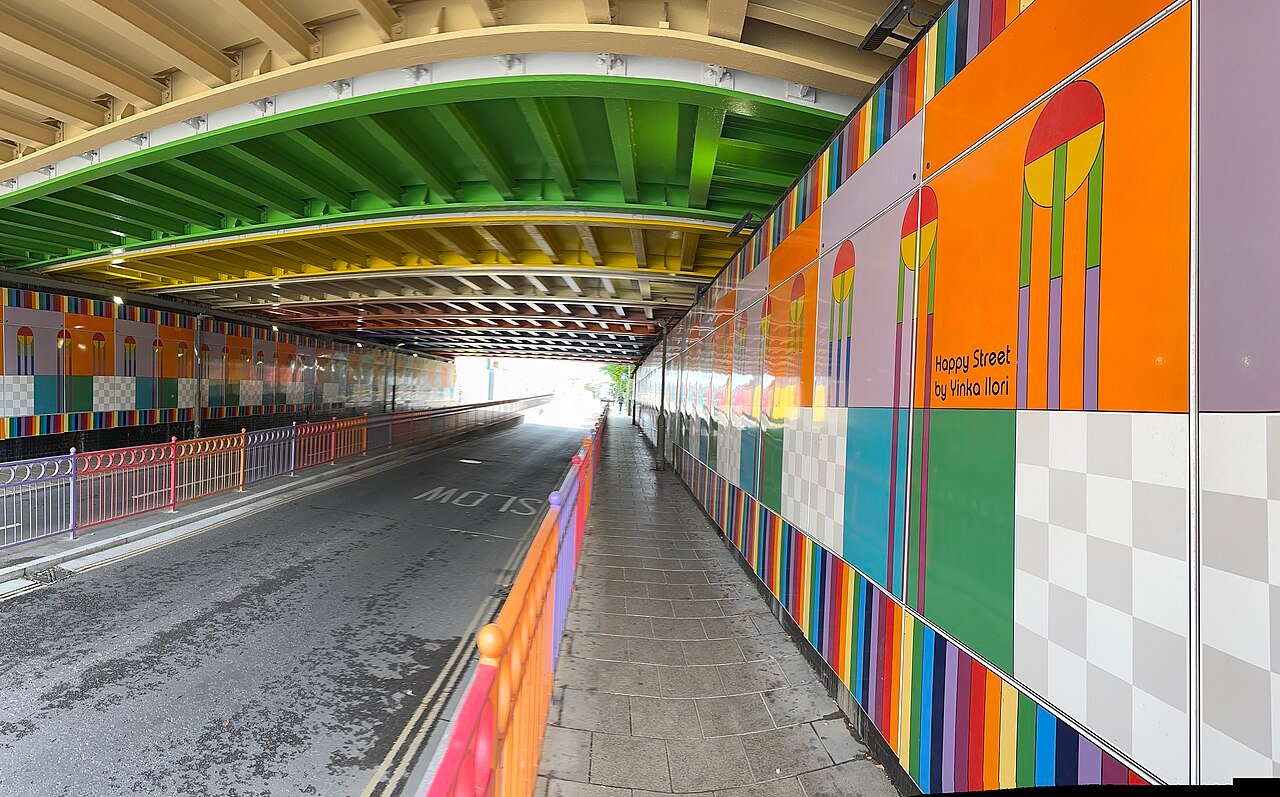
The scale has since expanded to architecture, graphics, public art and environments. Projects including the 2019 Colour Palace, a series of pedestrian crossings and the Flamboyance of Flamingos playground have put his visual language into spaces used collectively.
Joy as public infrastructure
Calling the work joyful is accurate but incomplete. Joy, in Ilori’s practice, is an active design brief: who feels invited, what a place communicates, and whether an everyday route can offer delight. Participation and accessibility are part of the form.
The Design Museum’s “Parables for Happiness” display brought together more than 100 objects, from furniture and textiles to personal possessions. It made visible the network of influences behind a public-facing aesthetic.
A London practice with an outward reach
Ilori studied at London Metropolitan University and now works from a Park Royal studio. He received the London Design Festival’s Emerging Design Medal in 2020, an MBE in 2021 and was named a Royal Designer for Industry in 2025.
The honours mark a growing international profile. Yet London remains legible in the work: not as a skyline, but as a lived mixture of inheritance, neighbourhood and encounter.